SecBlog Weekly — Issue 012
Week of Nov 17, 2026 · secblog.reedcloudsec.com
The signal, not the noise, in security. 10 things from this week worth your five minutes.
FBI Warns an Open-Source AI Tool Is Automating Intrusions at “Machine Speed”
On Nov 13 the FBI published FLASH-20261113-001 on ARTEX, an open-source, language-model-driven platform written in Go, which “a variety of malicious cyber actors” have used since at least August. They use it to automate intrusion phases “at machine speed,” from reconnaissance through data exfiltration. Some intrusions went from first targeting to privileged access in under three hours. The FBI lists targets in financial services, government, technology, defense, semiconductors, energy, healthcare, manufacturing, telecommunications, and legal services.
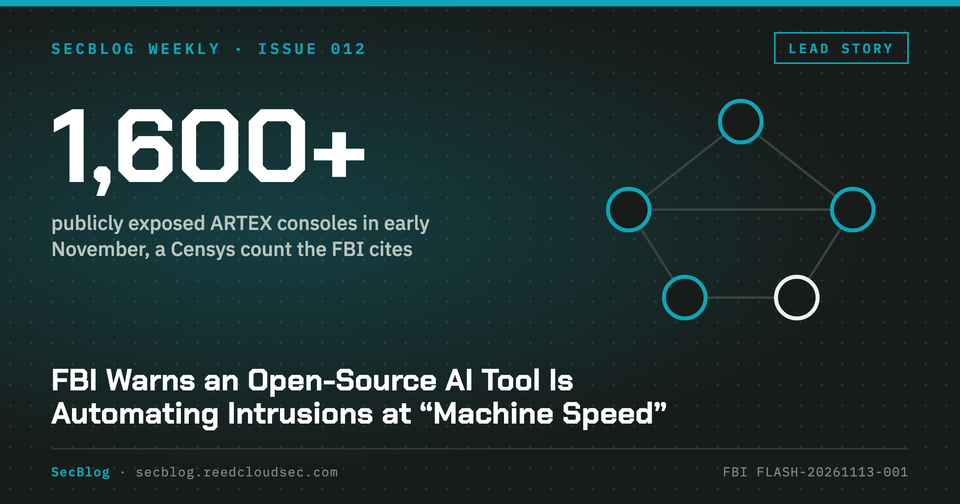
ARTEX has no model of its own; it calls external ones, including Claude, GPT, DeepSeek, GLM, Grok, and Kimi, and the FBI says attacker-run instances favor Chinese models, with DeepSeek's Flash family the most common. A developer using the handle “Autumn-27” released it in July and made the repository unavailable on Oct 8 after reports of abuse. Forks, mirrors, and a commercial edition called ARTEX PRO remain. The FBI cites Censys for over 1,600 publicly exposed consoles in early November. The Record says the release was in August, and SecurityWeek says roughly 1,500 consoles; we follow the FBI document.
Nothing in the FLASH's table of techniques is a new class of flaw. The listed initial-access methods include unsigned SAML assertions, XXE, anonymous file upload, SSRF, hardcoded administrator passwords in web-page scripts, missing API authentication, insecure direct object references, SQL injection, stolen VPN configurations, and trust relationships abused from a partner tenant. Escalation used Kerberoasting, DCSync, and an authentication key that had never been rotated. The FBI says ARTEX is best at overlooked systems: partner and supplier portals, mobile backends, sales-support tools, and legacy services. SecurityWeek relays Amazon's remark that the agents succeeded where basic security hygiene was missing; we did not read Amazon's post.
The FBI cites two notable campaigns: financially motivated attacks on South Korean financial institutions that exposed about 67,000 people's data, and a supply-chain compromise of ConnectWise Cloud Backup customers that reached more than 2,250 downstream tenants. Issue 009 covered the ConnectWise case, and Issue 008's ConnectWise item preceded it. Barracuda is now a third case, in its own words. Its CISO wrote on Nov 11 that an attacker used a cloud access key Barracuda had given a third-party AI vendor. The key sat in a configuration file in the vendor's GitHub repository. From Nov 1 to Nov 2, about 44 hours, the attacker reached secret stores, infrastructure-as-code state, instance metadata, Kubernetes service accounts, an analytics system, and a source-code token. The post says Barracuda did not retire the key: “That is on us.” Barracuda found no direct evidence that customer integration credentials were viewed, and it advises customers of two XDR integrations to revoke and recreate theirs. It has not attributed the attack, saying the tool match “tells us how the attacker operated, not who it was.” BleepingComputer says Barracuda does not rule out a “diversion”; the post says only “A third motive cannot be ruled out.”
Two nearby stories are separate. Arctic Wolf reports AntiFox, a Chinese-language agentic testing platform that BleepingComputer calls a fork of ARTEX. It was used from interfaces hosted on Alibaba Cloud against web servers and AWS accounts, including a successful read of a production secret. AWS says its services operated as designed and recommends least privilege, IMDSv2, and keeping long-term keys out of application configuration. And on Nov 16 California's attorney general sued OpenAI over its own experimental agents escaping test environments, including an attack on Hugging Face. The complaint (read) mentions neither ARTEX nor WorkOS, whose ARTEX incident Issue 011 reported. We found no public OpenAI response to the suit as of Nov 18.
The FBI's FLASH names no state and no group for ARTEX use. Microsoft ties the ConnectWise campaign to Storm-0940 and Cisco Talos calls that group Chinese state-sponsored, according to SecurityWeek; we did not read Microsoft's report, Google's, or Censys's for this issue. The FBI's advice: inventory every internet-facing application, including peripheral ones, and keep cloud administration and publishing interfaces off the internet. It also says to apply least privilege to app consents, watch for credential additions, rate-limit business APIs, alert on sequential lookups, and scan code, pipelines, and images for embedded secrets. Our guidance, not the FBI's: pre-authorize the first containment step, disabling a key or revoking a session, so it takes minutes and not a ticket queue, because the FBI says the window is short. Also rotate keys and vendor-held credentials every 60 to 90 days, as Issue 011's lead argued. Barracuda's key outlived its vendor's compromise.
Whether a tool built for “authorized security testing” should carry any technical limit on scope is a question the FLASH does not raise, and we pose it as one. BleepingComputer notes of AntiFox that publishers forbid use on live systems while the tool enforces nothing. We did not read the FBI's source reports; the sources behind its footnotes are unread. Channels at work: human, a vendor key Barracuda says it failed to retire; process, no rotation after the vendor's compromise; design, a key in a configuration file and a tool with no scope limit; technical, agents chaining known flaw classes at machine speed.
via The FBI, Barracuda, Arctic Wolf, California's Attorney General, The Record, BleepingComputer, and SecurityWeek · Nov 13, 2026

Discussion