SecBlog Weekly — Issue 011
Week of Nov 10, 2026 · secblog.reedcloudsec.com
The signal, not the noise, in security. 10 things from this week worth your five minutes.
Real Secrets Found in 1,122 Public Copies of Claude Code's “Don't Ask Again” File
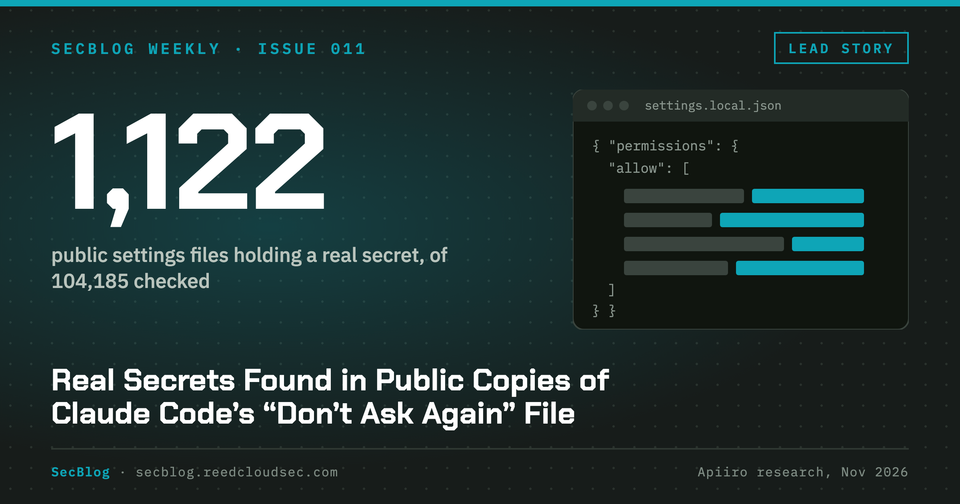
Apiiro searched public GitHub on Nov 1 to 3 and found 104,185 copies of .claude/settings.local.json in 103,617 repositories. In 1,122 of those files (1.1%, a count of files, not repositories) it found a real secret, 1,379 distinct secrets in all. Counting file history, shared settings files, and saved agent transcripts as well, the total is 2,539 across 1,994 repositories. The cause is Claude Code's own behavior. When it asks permission to run a shell command and the developer picks “Yes, and don't ask again,” it saves the approved command, secret included, as an allow rule in that file. More than a third of the secrets open a database directly, among them 379 database passwords and 122 Supabase service-role keys. Apiiro counts 63 organizations among the owners. A “real secret” means a key in a known provider format, or a password beside a public host, that an AI reviewer also accepted. Apiiro tested none of them, and one organization it notified confirmed its key was live.
Anthropic's documentation says Claude Code keeps the file out of git by adding it to the developer's global git excludes when it creates the file. Apiiro agrees, but notes the project's own .gitignore is never touched, so the protection does not follow a clone or a folder that becomes a repository later. Of 1,105 repositories with a real secret that Apiiro traced, 539 had a commit co-authored by Claude that changed the file. Boris Cherny, whom Apiiro identifies as Anthropic's head of Claude Code, replied on Hacker News on Nov 7: Claude Code has not scrubbed secrets, the team is looking at what to do, and in his view the exposed copies were created by hand and committed. He named auto mode and basic secret scanning as approaches to prototype. The Hacker News article, published before that reply, relays Apiiro's account that none of four earlier reports, filed since August 2025, got an answer from Anthropic and that three were closed automatically. Cherny's account and Apiiro's data measure different things, and neither settles how each copy reached GitHub. Disclosure: Claude Code is part of the tooling this newsletter is produced with, so weigh our coverage of it accordingly.
Two other findings from the same week point at the same files. Truffle Security's new Secrets Revocation Program says it has confirmed 1.4 million live leaked secrets since 2022. (BleepingComputer's headline says nearly 1.5 million; its text and Truffle's post say 1.4 million.) The program either revokes them through an issuer's endpoint or hands the issuer verified keys to revoke within 14 days. Sixteen issuers joined, including Hugging Face, Notion, Vercel, Resend, RubyGems, and Twilio. Truffle reports 2,655 working keys in AI coding tools' config files since January 2025, and that 81% of the keys it reported last year still worked six months later. On the endpoint, SpyCloud's Oct 30 report says the WardenStealer infostealer (more than 130,000 infections since Aug 3) copies Claude Code's OAuth and MCP tokens, Codex API keys, and Claude Desktop configuration. Aoki (first seen Oct 4) collects the local session folders of Claude Code, Claude Desktop, Codex, and other AI tools. SpyCloud says stolen AI tokens keep much of their access after a password reset but describes no test of that, and SpyCloud cannot confirm that everything on sale came from infostealers. None of these sources describes a breach of Anthropic's own systems. In August the company told some users that general-purpose infostealers such as Vidar, LummaC2, StealC, and RedLine had taken their Claude sessions, signed them out, and refunded unauthorized charges.
Both routes lead to the same files and tokens on a developer's machine. Apiiro's fixes are to keep secrets out of commands by referencing a variable such as $DB_URL, to approve patterns such as Bash(npm run:*) instead of literal commands, to treat .claude/, .cursor/, .gemini/, and .specstory/ like .env, and to untrack a committed file with git rm --cached. Rotate every secret the file ever held, since history, forks, and clones keep the old copy; removing a file is not revoking a key, as Issue 009's LiteLLM item showed. Scanners help only partly: gitleaks flagged 564 of the 1,122 files, TruffleHog 643, and 215 slipped past both, because a password after PGPASSWORD= or sshpass -p reads like ordinary text. After an infostealer infection, removing the malware and revoking sessions and tokens matters more than a password reset. It is the same lesson as JadePuffer's secrets-never-in-repos point and Supabase's plaintext-secret purge in Issue 005, now with an agent writing the file, and Issue 009's AGENTS.md hijack showed agent folders are an attack surface too.
Our guidance goes further, and it is ours, not a sourced finding. No secret should be typed into a prompt or a command at any moment. Use a placeholder that resolves from a secrets manager or the shell environment, so the value never appears in the conversation, the command line, or the allow list. Treat fully automatic execution as a risk for any command that touches a credential. Run those commands yourself in your own terminal, or have the tool hand you the command with the secret supplied from the environment. Anthropic's lead recommends auto mode, which he says is significantly safer in practice than manual approval. A Hacker News reader pointed out that the same exposure can arise there when it asks about a sensitive command, and Cherny called that a good catch, as Apiiro's update reports. We would keep a person in the loop for any command that carries a credential.
Rotate on a schedule, not only after an incident. Truffle found that 81% of the keys it reported last year still worked six months later, so six months is a long time for a leaked key to stay valid. We recommend 60 to 90 days for API keys, tokens, and service-account passwords, and short-lived tokens that expire on their own where the provider offers them. That figure is our guidance, not a published standard. Human passwords are different: NIST's SP 800-63B-4 says verifiers shall not require periodic password changes, though they shall force a change on evidence of compromise, so for those the trigger is a compromise, not the calendar. On length, the same document requires at least 15 characters for a password used alone (8 when it is one factor among several), says verifiers should allow at least 64, and bars rules that force a mix of character types.
Behind the mechanism is a human question we pose as open, not as a finding. Cherny describes the threat model himself: a person who must approve many commands gets tired and approves one they should not. Apiiro says most people stop reading after the tenth prompt. We think fatigue should be treated as a condition to measure, not to assume away. A tool that knows how many approvals it has asked for in a session could count them, warn as the count climbs, and require a deliberate step before any command that carries a credential. We did not find a source saying any tool does this, and we pose it as an open question whether it should, and whether secret hygiene should depend on a tired person's attention at all. That is Issue 005's human approval gate under pressure. Channels at work: human, approval fatigue, which Anthropic's lead and Apiiro describe; process, secrets typed into commands and keys still valid months later; design, a plaintext allow rule whose protection does not travel; technical, infostealers that copy local token files.
via Apiiro, Truffle Security, SpyCloud, Anthropic, The Hacker News, and BleepingComputer · Nov 7, 2026

Discussion